
Table of Contents
What Is Chilliwack Winterization Service and Do You Need One?
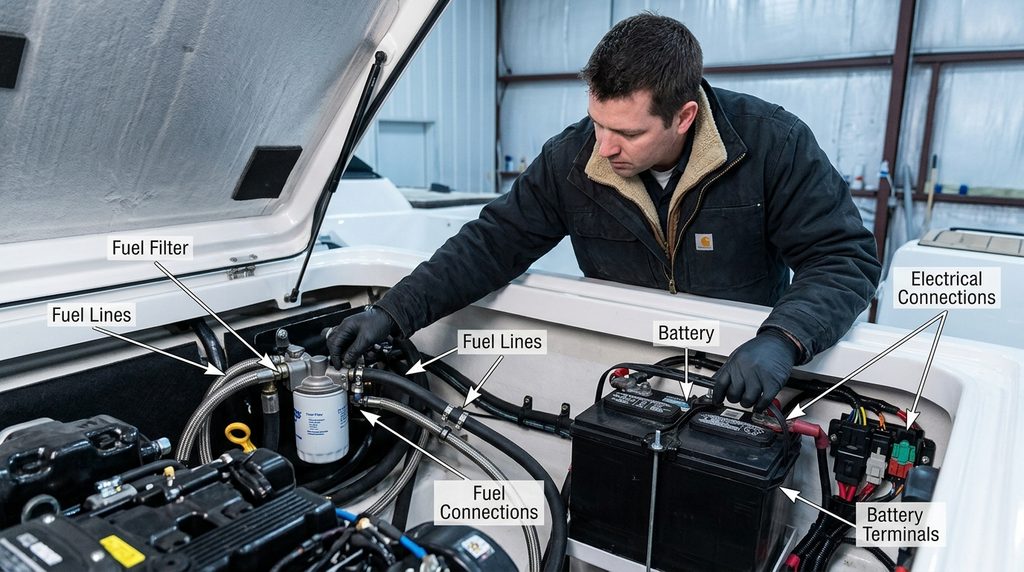
Direct answer: Yes — if your boat sits outdoors or in unheated storage anywhere around Chilliwack over winter, a Chilliwack winterization service is what stands between your engine and a cracked block by spring. It clears water and vulnerable fluids out of your engine, cooling passages, drive unit, fuel system, and battery before freezing temperatures arrive, and in the Fraser Valley that window typically closes by late October.
Here’s what the process actually involves, why pricing shifts from boat to boat, what a technician checks beyond the engine, and how to know if this is a job for you or a professional.
Why Does a Boat Need Winterizing Before Chilliwack’s Winter?
Water expands by roughly 9% when it freezes. Inside a rigid engine block or a sealed cooling passage, that expansion has nowhere to release — so it pushes against the metal until something cracks. A split engine block, a ruptured manifold, or a burst hose are the typical results, and none of them are cheap or quick to fix.
Chilliwack and the wider Fraser Valley see colder overnight temperatures than coastal Vancouver, with the first hard frost usually arriving by late October. A Chilliwack winterization service helps get every vulnerable system prepared before that first freeze can cause damage. This isn’t unique to marine engines either — the same freeze-expansion risk is why RV owners in the same region are told to winterize plumbing lines before the seasonal deadline.
What Does a Chilliwack Winterization Service Actually Include?
The process runs through the boat system by system, and the scope depends heavily on your engine type:
| Engine Type | What Gets Serviced | What’s Skipped |
|---|---|---|
| Outboard | Fogging the cylinders, fuel stabilization, battery check, hose inspection, gear oil (lower unit) | No separate drive-unit or sterndrive service needed |
| I/O / Sterndrive | Everything an outboard needs, plus gear lubricant inspection, drive-unit check, propeller/shaft inspection, and cooling-system draining | Nothing — the most complete process of the three |
| Inboard | Cooling system draining or antifreeze treatment, oil and filter change, fuel stabilization, battery check | No external drive unit to service |
On the engine side, oil gets changed because oil that’s carried a full season of running holds moisture and acid that shouldn’t sit for months. Outboards get “fogged” — a light oil coating sprayed into the intake to stop internal rust from forming during storage.
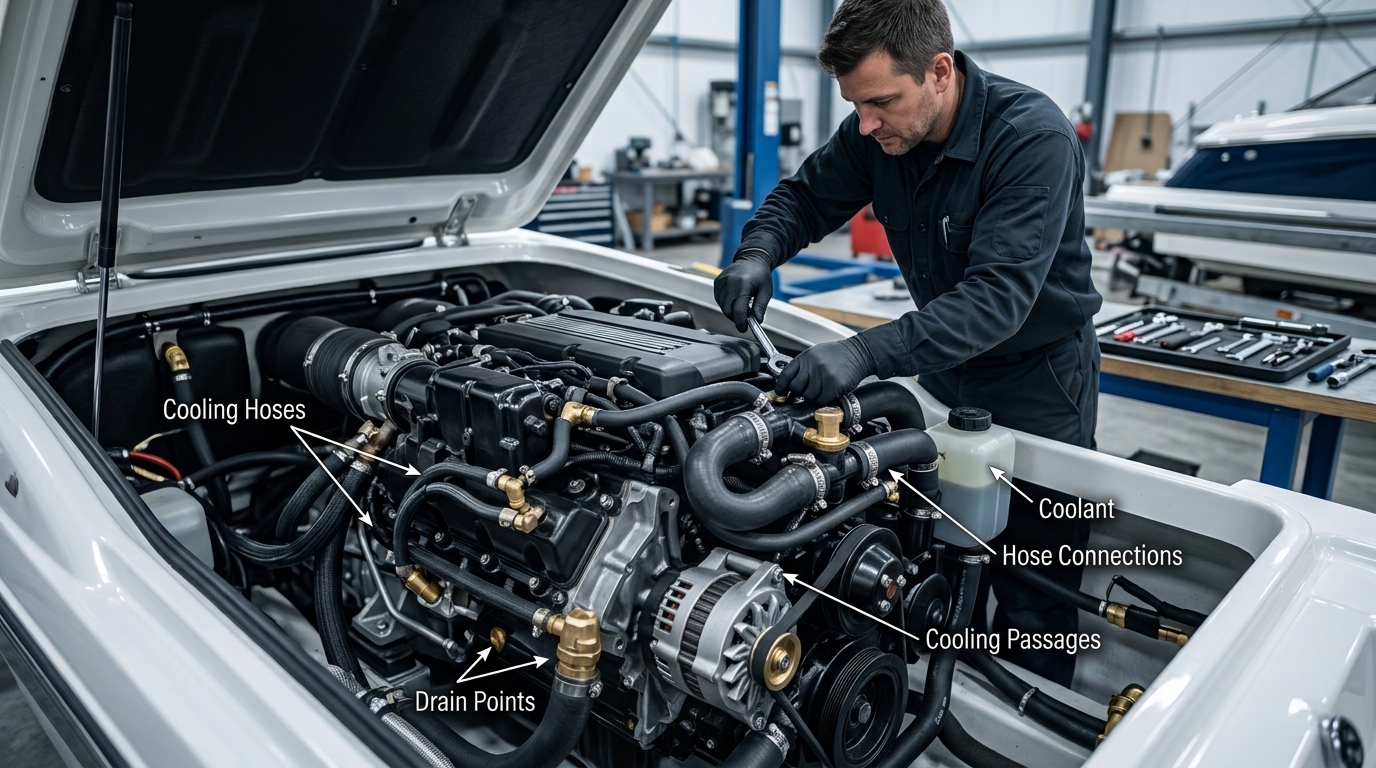
On the cooling side — the area where most freeze damage actually happens — the approach depends on the engine’s cooling design. Some engines use a raw-water (seawater) cooling loop, where water moves through the engine directly and must be fully drained before storage. Others use a closed freshwater loop cooled by an internal antifreeze mixture, where the technician instead checks that the coolant’s concentration is strong enough for the coldest nights the storage location will see. Manufacturer guidance for popular sterndrive engines — Mercury’s MerCruiser line, for example — spells out drain points and procedures specific to each engine family, which is why a generic “drain and done” approach isn’t reliable across different boats.
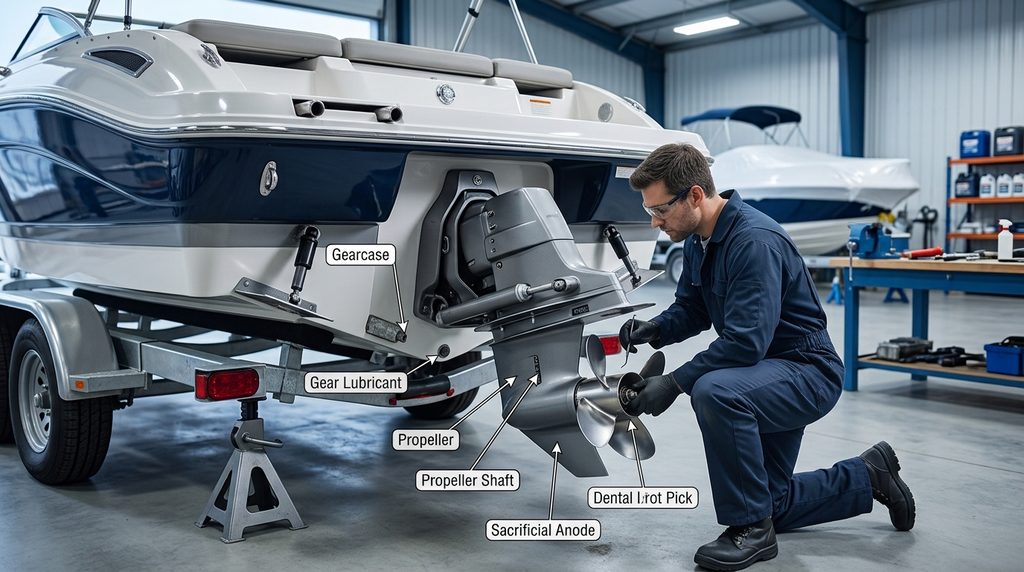
On the drive side, for I/O and sterndrive boats, gear lubricant gets pulled and inspected, not just topped up. Cloudy or milky lubricant is a warning sign that water has already entered the gearcase — and the fix isn’t a lubricant change, it’s finding how the water got in and addressing that first.
watch our oil change service video.
Does the Propeller and Shaft Need Attention Too?
Yes, and it’s one of the most commonly skipped steps in a rushed winterization. The propeller and shaft should be checked for corrosion, visible damage, and fishing line or rope wrapped around the shaft — material that can work its way past the seals and cause slow leaks that aren’t obvious until spring. A quick inspection here during winterization is far cheaper than discovering seal damage after the season has already started.
What Other Components Should Be Checked Beyond the Engine?
A thorough Chilliwack winterization service doesn’t stop at the propulsion system. A few areas that are easy to overlook:
- The bilge — standing water, debris, or a slow leak can go unnoticed for months in storage and should be checked and cleared before the boat sits idle.
- Hoses, clamps, and belts — small cracks or loose clamps rarely cause problems mid-season but can fail after months of temperature swings in storage.
- Onboard freshwater systems — sinks, showers, and water heaters hold water independently of the engine’s cooling system, and they’re frequently not included in a standard winterization package unless you specifically ask. Skipping this step means a boat can come out of “complete” winterization with a cracked water heater or split plumbing line anyway.
How Should a Sterndrive Be Stored Over Winter?
Storage position matters more than most owners expect. Current manufacturer guidance for MerCruiser sterndrives recommends keeping the drive in the down position when the boat is stored outdoors, so rainwater and snow don’t collect and pool inside the drive housing. This is a small detail, but it’s exactly the kind of thing a generic winterization checklist skips — the correct position can vary by drive model, so it’s worth confirming directly rather than assuming one rule applies to every sterndrive.
Why Does Pricing Vary So Much for a Chilliwack Winterization Service?
There’s no single flat number here, and any quote given before a technician sees the boat is a rough estimate at best. Industry-wide cost surveys across North America give a useful reference point, even though local BC pricing will differ somewhat:
| Approach | General Industry Range (Reference Only) | Notes |
|---|---|---|
| DIY supplies (antifreeze, fogging oil, basic kit) | Roughly $50–$125 | Requires your own time, tools, and confidence with the procedure |
| Independent mobile mechanic | Often quoted lower than shop rates | May add a separate travel or call-out fee |
| Marine repair shop | Commonly cited in the $300–$450 range for smaller boats | Full-service, typically includes oil, filter, and fluid checks |
| Full-service marina package | Can run $450–$600+ | Sometimes bundles winterization with shrink-wrap and spring de-winterization |
| Larger vessels / twin engines | Priced higher, sometimes per foot of boat length | Reflects roughly double the inspection and service time |
Important: these are general industry reference ranges pulled from wider marine-cost data, not a quote from any specific Chilliwack provider. The real cost drivers on your specific boat are:
- Number of engines — twin-engine boats are close to double the inspection and service time, not by accident but because there’s genuinely twice the work
- Engine type — outboards skip the gear-lubricant, propeller-shaft, and drive-inspection steps entirely, shortening the job compared to a sterndrive
- What’s found mid-service — a corroded hose clamp or a failing water pump discovered during inspection gets quoted separately, never folded silently into the original estimate
- Cooling-system design — raw-water and closed-loop systems aren’t prepped the same way, and one takes meaningfully longer than the other
The practical move isn’t chasing the lowest advertised number — it’s requesting a written, itemized quote once the provider knows your actual engine and boat.
watch our Boat tune up video.
When Should You Book a Chilliwack Winterization Service?
A workable rule: as soon as your boating season ends, start the booking conversation. Waiting until frost warnings show up in the forecast means competing with every other boat owner who had the same idea at the same time — and the final two weeks of October are consistently the busiest stretch for marine service shops across the Fraser Valley.
you can watch our Chilliwack Winterization video and see the details.
A practical timeline:
- Early-to-mid September — start contacting providers as the season winds down
- Late September to mid-October — the ideal booking window, with the best slot availability
- Late October onward — high-risk territory; book immediately if you haven’t already
What Should You Have Ready Before Booking?
Walking into that first conversation with clear answers gets you an accurate quote instead of a placeholder number that changes once the technician sees the boat:
- What’s the engine brand and model — Mercury, Yamaha, Volvo Penta, or another?
- Is it a single or twin-engine setup?
- Is it an outboard, I/O/sterndrive, or inboard?
- Where will the boat be stored — indoors, outdoors covered, or fully exposed?
- Are there any known issues — an unusual noise, a leak, or a warning light?
- Does the boat have onboard freshwater systems that also need prepping?
How Do You Choose the Right Provider?
Price shouldn’t be the only filter. A few questions worth asking before booking:
- Does the technician have experience with your specific engine brand and configuration, not just “boats in general”?
- Will you get an itemized estimate, or just a single rounded number?
- How are additional issues found during inspection handled — quoted separately, or is there a surprise on the final bill?
- Does the service include the propeller, shaft, bilge, and freshwater systems, or only the engine and cooling system?
A provider who explains what’s included clearly, before you book, is usually a better signal of quality than the lowest advertised starting price. You can get in touch to request a quote once you know your engine type and storage plan, or check AOK Boat services if you’re comparing providers in the area first.
Should You DIY Your Winterization or Hire a Professional?
This comes down to comfort level more than budget. An owner who knows exactly where their engine’s drain points are, and has the correct antifreeze on hand, can complete the process correctly without professional help. The real risk isn’t cost — it’s the step you don’t know you’re missing: a drain point you didn’t realize existed, or a cooling loop that needs a different antifreeze ratio than the one you bought. A Chilliwack winterization service can help identify these engine-specific requirements and make sure the system is properly prepared.
If nobody has walked you through your specific engine’s cooling system before, that’s usually the signal to bring in a technician for at least the first season — you can watch the process and take it on yourself in later years.
check our Boat engine video if having engine issues.
What Are the Most Common Winterization Mistakes?
- Assuming every boat follows the same procedure — outboard, I/O, and inboard systems all differ, and even two sterndrive boats can differ by cooling-system design
- Waiting until freezing weather to book — by then, slots are limited across the whole region
- Treating the engine as the only thing that matters — the propeller, shaft, bilge, battery, and freshwater systems are just as capable of causing a spring headache if skipped
- Ignoring cloudy or milky gear lubricant — this signals water contamination that a simple fluid change won’t fix on its own
- Assuming indoor storage means winterization isn’t necessary — it lowers risk but doesn’t eliminate the need for cooling and fuel-system preparation
Watch our Boat Repair trust video.
What Happens If You Skip or Rush a Chilliwack Winterization Service?
The most common outcomes when winterization gets skipped or rushed:
- A cracked block or manifold from frozen trapped water — often not discovered until the first start attempt in spring
- A gearcase full of water-contaminated lubricant that’s been silently corroding internal components all winter
- Fuel-system deposits from untreated fuel sitting for months, leading to hard starts or a no-start situation
- Battery failure from improper winter storage, needing a full replacement rather than a simple recharge
- A damaged or leaking seal from fishing line left wrapped around the propeller shaft, discovered only once the boat is back in the water
None of these show up immediately, which is exactly what makes skipping winterization easy to justify in October and expensive to regret in April.
What’s the Difference Between Winterization and De-Winterization?
These two terms get confused often enough that it’s worth separating clearly. Winterization is the fall process covered throughout this guide — preparing the boat for months of cold, unused storage. De-winterization is the reverse process done in spring: removing antifreeze from the cooling system, reinstalling or reconnecting the battery, replacing fogging oil residue, and running the engine to confirm everything survived the winter correctly.
Some providers price these as two separate services; others bundle both into a single seasonal package. If you’re booking a Chilliwack winterization service for the first time, it’s worth asking upfront whether spring commissioning is included, discounted as a package, or billed separately later. You can also review AOK Boats’ boat winterization service to understand what may be included in seasonal preparation. This helps you estimate the total cost for the full season rather than just the fall service.
Frequently Asked Questions
What does a Chilliwack winterization service include? A Chilliwack winterization service typically covers the engine, cooling system, fuel stabilization, and battery at minimum. I/O and sterndrive boats may also receive gear-lubricant inspection, drive-unit service, and a propeller and shaft check. Freshwater plumbing is often excluded unless specifically requested.
How much does a Chilliwack winterization service cost? The cost depends on your engine type, number of engines, cooling-system design, and any repairs found during inspection. Basic DIY supplies may cost less, while full-service marina packages can cost significantly more. An itemized quote based on your specific boat is more reliable than a general price range.
When is the best time to book a Chilliwack winterization service? It is best to arrange your Chilliwack winterization service soon after the boating season ends and before freezing temperatures arrive. Booking early can give you time to address any problems discovered during the inspection.
Is DIY winterization a good option for beginners? DIY winterization may be suitable for experienced boat owners who understand their engine’s drain points and antifreeze requirements. For beginners, a professional Chilliwack winterization service can help reduce the risk of missing an important step.
Does a boat stored indoors still need winterizing? In most cases, yes. Indoor storage can reduce exposure to weather, but it does not automatically protect the cooling, fuel, battery, and other systems from seasonal problems.
Is cloudy sterndrive gear lubricant a serious issue? It can indicate that water has entered the gearcase. Simply replacing the lubricant without identifying the source of the water may allow the problem to return. A proper Chilliwack winterization service should identify concerns that require further inspection.
Should the propeller be checked during winterization? Yes. Fishing line, rope, corrosion, or damage around the propeller and shaft can affect seals and propulsion components. Including this inspection in a Chilliwack winterization service can help identify problems before the next boating season.
How should a sterndrive be stored outdoors? Storage position can depend on the specific drive and manufacturer instructions. For example, MerCruiser guidance recommends the down position for certain outdoor-storage situations. Always follow the instructions for your specific model.
Can winterization be combined with other maintenance? Yes. Winterization is a convenient time to inspect related components and address worn hoses, aging batteries, fluid concerns, or other issues before the boat is stored.
What’s the Bottom Line on Chilliwack Winterization Service?
A Chilliwack winterization service is an important part of preparing a boat for seasonal storage. A complete service should consider more than the engine alone, including the cooling system, fuel system, battery, drive unit, propeller and shaft, bilge, and applicable freshwater systems.
Booking your Chilliwack winterization service before freezing weather gives you an opportunity to identify and address potential problems before they become larger spring-startup repairs. When requesting a quote, ask exactly what is included so the boat’s important systems are not overlooked.


