
Table of Contents
What Does Chilliwack Engine Installation Actually Involve?
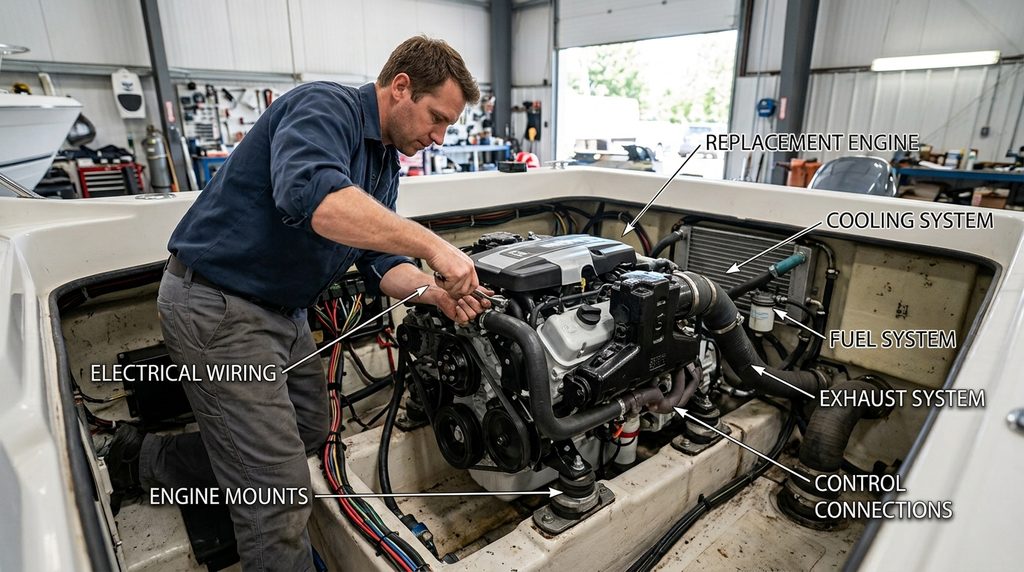
Direct answer: Chilliwack engine installation is the process of mounting a new or replacement engine into a boat and fully integrating it — mechanical mounting, fuel and cooling connections, exhaust routing, electrical and control wiring, propeller matching, and a proper break-in run before the boat returns to the water. It’s not interchangeable with a simple repair: the engine has to match your boat’s rated horsepower limit and hull design, or it creates a real legal and safety problem, not just a performance one.
Below: what the process covers stage by stage, what changes the cost, the one regulation almost every installation guide skips, and how to choose between repowering and buying a different boat.
Why Would a Boat Need a New Engine Installed?
There are two situations that both fall under Chilliwack engine installation:
- A repower — replacing an aging, unreliable, or failing engine on a boat you already own and like. This is usually driven by an engine that’s become too expensive to keep repairing, is showing worsening corrosion, or simply can’t get parts anymore.
- A first-time or replacement installation — fitting an engine to a boat that didn’t come with one, such as a used hull purchased without power, or one that’s had its engine fully removed.
Both call for the same core mechanical and electrical work, but a repower has one real advantage: you already know how the boat handles and performs, so matching a new engine’s specs to that known baseline is more predictable than starting from zero.
Is There a Legal Limit on What Engine You Can Install?
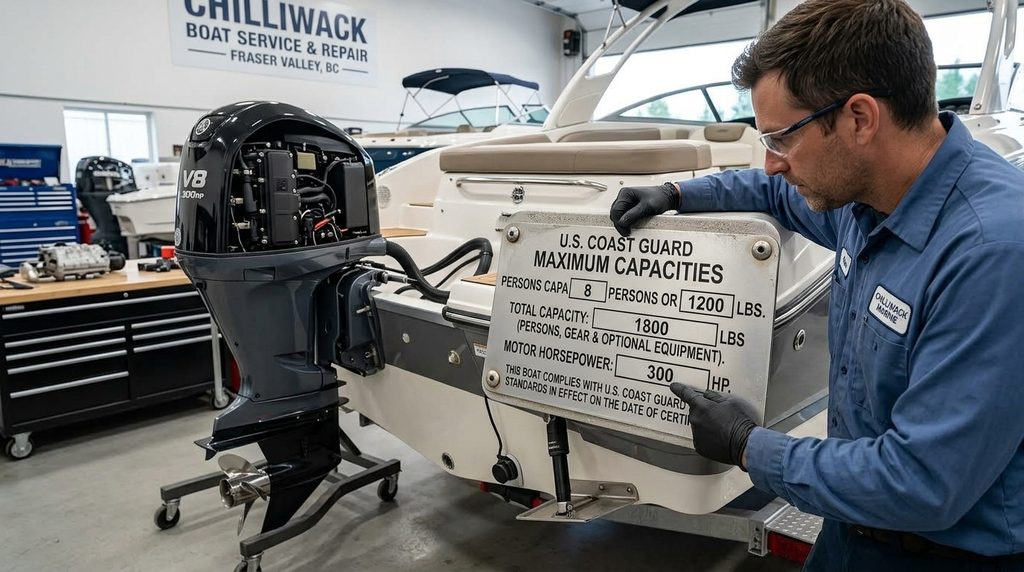
Yes — and it’s the part most Chilliwack engine installation guides never mention. In Canada, boats under 6 metres must carry a capacity plate (also called a compliance notice) stating the maximum permissible horsepower for that specific hull. This isn’t a recommendation; installing an engine that exceeds the rated horsepower on the plate puts the boat out of compliance with its safety standards, on top of the genuine handling risk that comes with overpowering a hull the manufacturer never tested at that output.
The rating exists because the manufacturer tested that hull for the stress a given horsepower places on the transom, the mounting points, and the boat’s balance. Exceeding that number isn’t just a compliance issue — Transport Canada’s Office of Boating Safety treats unsafe handling from ignoring rated limits as a real enforcement matter, not a technicality.
Practical takeaway: before choosing an engine, check your capacity plate — usually mounted near the helm or on the transom — and confirm the horsepower you’re considering sits at or under that number.
What Does a Full Chilliwack Engine Installation Include?
The table below breaks down what a proper Chilliwack engine installation covers, by engine configuration:
| Installation Stage | Outboard | I/O / Sterndrive | Inboard |
|---|---|---|---|
| Mechanical mounting | Transom mounting, height/setback adjustment | Engine bed mounting plus drive-unit integration | Engine bed mounting, alignment to shaft |
| Cooling system | Direct connection, simpler routing | Raw-water or closed-loop setup, more complex | Raw-water or closed-loop, engine-room routing |
| Drive/propeller alignment | Lower-unit gear, prop matched to engine | Sterndrive alignment, prop shaft integration | Shaft alignment through the hull, coupling |
| Electrical/controls | Ignition, gauges, throttle/shift cables | Same, plus drive-trim wiring | Same, plus engine-room instrumentation |
| Fuel system | Line connection, filtration | Line connection, filtration | Line routing through engine room, filtration |
| Break-in period | Manufacturer RPM limit, typically several hours | Same | Same |
Engine bed condition matters as much as the engine itself. A new engine depends on a solid, undamaged foundation — the engine bed, motor mounts, and stringers should be inspected for rot, cracking, or structural weakness before installation. If any of that structure has degraded, fitting a new engine on top of it without addressing the foundation first undermines the whole Chilliwack engine installation, regardless of how well the engine itself is mounted.
Rigging is often underestimated. Wiring harnesses, fuel lines, cooling lines, steering, and — on newer engines — digital throttle and NMEA-compatible instrument integration all fall under “rigging,” and it’s frequently the most time-consuming part of the job, especially on a repower where the old engine used a different control system than the new one.
Installation work in the marine industry — including Chilliwack engine installation — is also guided by voluntary technical standards, not just manufacturer manuals. The American Boat & Yacht Council (ABYC) publishes specific guides covering exactly this work — including a dedicated outboard engine mounting guide and a standard for inboard engines and transmissions — and reputable installers typically build their process around these standards rather than improvising mounting and rigging procedures from scratch.
New Engine, Remanufactured, or Just a Repair?
Not every engine problem calls for a full Chilliwack engine installation. A useful way to think about it:
- Repair makes sense when the issue is isolated — a failed water pump, a worn impeller, a single bad component — and the engine is otherwise sound.
- Replacement makes sense when repair costs start approaching a significant share of the engine’s value, or when corrosion and wear have spread across multiple systems rather than one part.
- A remanufactured engine can be a middle path — lower cost than a factory-new unit while still resetting wear on major internal components, though it won’t carry the same technology or warranty terms as new. If your existing drive unit or propeller is also showing wear, it’s often worth addressing propeller condition and outdrive condition at the same time as the engine, rather than as separate visits later.
Signs that point toward replacement rather than repair include persistent overheating, excessive smoke, hard starting that keeps recurring, noticeable vibration, and repair bills that keep coming back for the same underlying engine.
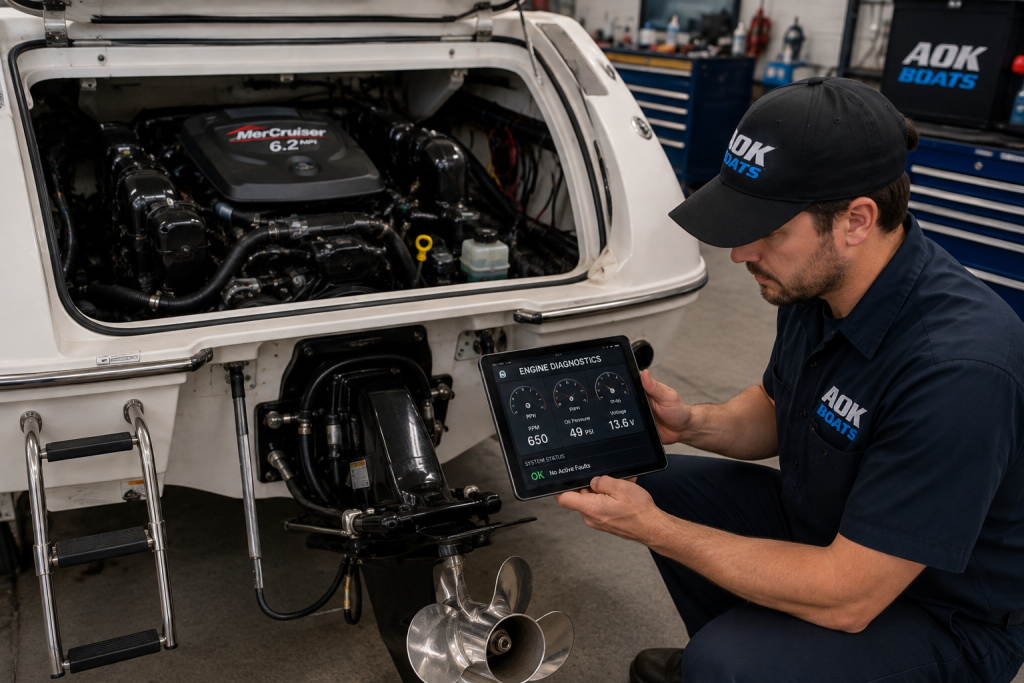
What Determines the Cost and Timeline of Chilliwack Engine Installation?
There’s no single flat number, since scope varies by situation:
- Repower vs. new installation — a repower onto an already-rigged boat is typically faster than a full installation requiring fresh rigging from scratch
- Engine type — outboard installation is generally quicker than inboard or sterndrive work, which often requires more engine-bay access and alignment work
- Engine-bed condition — if the bed, stringers, or mounts need structural repair first, that adds real time before the engine itself goes in
- Rigging reuse vs. replacement — old cables, wiring, and fuel lines that need replacing add both labor and material cost
- Propeller matching — whether the existing propeller works with the new engine’s output or needs to be re-pitched or replaced
Because of this range, the practical approach to Chilliwack engine installation is a written, itemized estimate based on your actual boat and chosen engine — not a flat advertised rate that doesn’t yet account for what your specific hull needs.
Does Engine Size Change What’s Involved in Installation?
Yes, and not always in the way people expect. A larger engine isn’t just “more of the same work” — it changes what the installer has to check and account for:
- Smaller outboards (under roughly 90 hp) are usually the fastest installs, with fewer rigging complications and lighter mounting requirements.
- Mid-range outboards and smaller sterndrives often introduce more complex rigging — power steering, trim systems, and multi-function displays that need proper integration rather than a simple swap.
- Larger sterndrives and inboards bring in more significant weight-distribution considerations. A heavier engine changes how the boat sits at rest and underway, which is part of why the horsepower rating on your capacity plate exists in the first place — it accounts for how much weight and power a given hull was designed to carry safely.
- Twin-engine setups, regardless of size, roughly double both the mechanical and electrical work, since alignment, wiring, and control integration have to be mirrored and synchronized across both engines rather than handled once.
This is also where the earlier point about the capacity plate becomes practical rather than theoretical: jumping to a larger engine “for more power” without checking the plate first is one of the more common — and avoidable — mistakes in a Chilliwack engine installation decision.
Repower or a Different Boat — Which Makes More Sense?
Repowering makes sense if:
- The hull, trailer, and other systems are in good condition
- You already know and like how the boat handles
- The cost of a new engine is meaningfully less than replacing the whole boat
A different boat might make more sense if:
- The hull itself has structural issues beyond the engine
- You’re looking to change size, layout, or capacity significantly
- The price gap between repowering and buying newer used is small
A simple way to frame it: if everything except the engine still has useful life left, repowering typically protects more of your existing investment than starting over. If you’re weighing this decision, talk to a repower specialist before deciding — a hands-on assessment of your specific hull is more reliable than a general rule of thumb.
What Should You Ask Before Booking Chilliwack Engine Installation?
- Does the quote include rigging (wiring, fuel lines, controls), or only the engine mount itself?
- Is the engine bed being inspected as part of the process, and how are repairs to it handled if found?
- Is the propeller included, or priced separately based on what the new engine needs?
- Is a break-in run included, or left to the owner to manage?
- Will the installer confirm your engine choice is within your boat’s rated horsepower limit before starting?
That last question is worth insisting on — a reputable installer should raise the capacity-plate limit themselves rather than leaving it for you to research after the fact. You can request a written estimate for Chilliwack engine installation once you know your engine choice and current rigging condition. You can also watch our Marine Engine Installation video for more information.
How Do You Choose the Right Provider for Chilliwack Engine Installation?
Not every marine shop handles Chilliwack engine installation the same way, and the gap between a rushed job and a properly done one usually shows up months later, not on delivery day. A few things worth checking before committing to a provider for Chilliwack engine installation:
- Do they inspect the engine bed before quoting, or only after the old engine is already out? Finding structural issues mid-job, rather than during the initial assessment, tends to extend both timeline and cost in ways that could have been flagged upfront.
- Do they work with your specific engine brand regularly, or is this a one-off for them? Familiarity with a brand’s mounting patterns, wiring conventions, and known quirks speeds up the job and reduces the chance of a wiring or calibration issue after installation.
- Is a sea trial or on-water test included after installation? Bench testing an engine is not the same as confirming it performs correctly under real load, at real RPM, on your actual boat.
- Are digital controls and instrument integration part of their standard process, if your new engine supports them? Older shops accustomed to simpler mechanical controls sometimes treat digital throttle and NMEA integration as an afterthought rather than a core part of Chilliwack engine installation.
A provider who walks through these details unprompted, rather than waiting to be asked, is usually the stronger signal — for Chilliwack engine installation specifically, local familiarity with the boats and conditions common to the Fraser Valley is a genuine advantage over a shop that only occasionally handles marine repowers.
Why Do Marine Engines Fail Faster Than Expected Without Proper Chilliwack Engine Installation?
A few conditions accelerate engine wear well beyond normal use, and they’re worth understanding before you decide between repair and replacement:
- Corrosion from moisture exposure. Constant dampness — even in freshwater environments like the Fraser River — attacks internal components over time. Left unaddressed, corrosion reduces fuel efficiency long before it causes outright failure, which is why a “sudden” engine problem often has months of buildup behind it.
- Electrical faults from neglected connections. Weak batteries, corroded terminals, and loose wiring don’t just cause starting problems — they can create inconsistent power delivery that stresses other components over time. A marine electrical inspection alongside installation catches most of this before it becomes a bigger issue.
- Fuel system contamination. Restricted filters, deteriorated hoses, or fuel that’s sat too long all reduce performance gradually, often mistaken for “the engine getting old” rather than a fixable fuel-delivery issue.
- Cooling system restrictions. Reduced water flow from worn impellers or scaled passages leads to overheating, which is one of the most common root causes behind engines that seem to fail without warning. If your boat runs an outboard, this is worth checking alongside your outboard maintenance schedule, since neglected cooling checks often show up first during seasonal service.
None of these are reasons to assume replacement is automatically necessary — but they’re useful context when an installer is helping you decide between a repair and a full engine replacement.
Does Timing Matter for Booking Chilliwack Engine Installation in the Fraser Valley?
Yes, though for different reasons than seasonal services like winterization. Chilliwack engine installation isn’t weather-dependent in the same way, but booking around the boating season still matters:
- Late winter/early spring is typically the best window — installers have more schedule flexibility before the season’s rush, and you avoid losing usable boating weeks to a mid-summer installation queue.
- Mid-summer bookings often mean longer wait times, since shops are simultaneously handling routine repairs and warranty work during peak season.
- Fall bookings can work well if you’re planning to have the boat ready and rigged before the following season, using the off-season for a more thorough installation without time pressure.
Whatever the timing, the constant across all of it is that engine and rigging component availability can affect the schedule as much as labor time — confirming parts availability for your specific engine choice before committing to a date avoids the most common source of installation delays. If you’re also due for a spring commissioning check around the same time, it’s worth asking whether both can be scheduled together.
Frequently Asked Questions
What’s included in Chilliwack engine installation? A full Chilliwack engine installation covers mechanical mounting, fuel and cooling connections, exhaust routing, electrical and control wiring, propeller matching, and a break-in run. Scope shifts depending on whether existing rigging is being reused or replaced.
Can I install any engine I want on my boat? No. Boats under 6 metres in Canada carry a capacity plate stating the maximum permissible horsepower for that hull. Installing an engine above that rating is a safety-standards violation, separate from the real handling risk it creates.
How long does Chilliwack engine installation take? It depends on whether it’s a repower onto existing rigging or a full Chilliwack engine installation requiring new rigging, plus whether the engine bed needs any structural repair first. A straightforward repower is typically faster than a first-time installation.
Is repowering cheaper than buying a new boat? Usually, yes — if the hull and other systems are in good shape, repowering protects the value of what you already own instead of starting over on a full purchase.
Does Chilliwack engine installation include the propeller? Not always by default. The right propeller depends on the new engine’s output and how the boat is typically used, so it’s worth confirming whether propeller matching is part of the quoted cost.
Should I repair my engine or replace it? Isolated issues on an otherwise sound engine usually favor repair. Recurring problems, spreading corrosion, or repair costs approaching a large share of the engine’s value point toward replacement instead.
What happens if I skip the break-in period? Skipping or rushing it can shorten the life of internal engine components. Most manufacturers specify an RPM limit for the first several hours of operation, and this should be included in a proper installation service.
Does the engine bed need to be inspected during Chilliwack engine installation? Yes — a new engine depends on a solid, undamaged foundation. Rot, cracking, or weakness in the engine bed or stringers should be addressed before the engine is mounted, not after.
Bottom Line
Chilliwack engine installation goes well beyond bolting a new engine onto a transom — it means matching that engine legally and mechanically to your specific hull, confirming the engine bed can support it, wiring everything correctly, and running a proper break-in before it sees full use. Before choosing an engine, check your boat’s capacity plate for the maximum rated horsepower, get an itemized quote that makes clear whether rigging, engine-bed inspection, and the propeller are included, and confirm your provider is genuinely set up for Chilliwack engine installation rather than treating it as an occasional side job.


